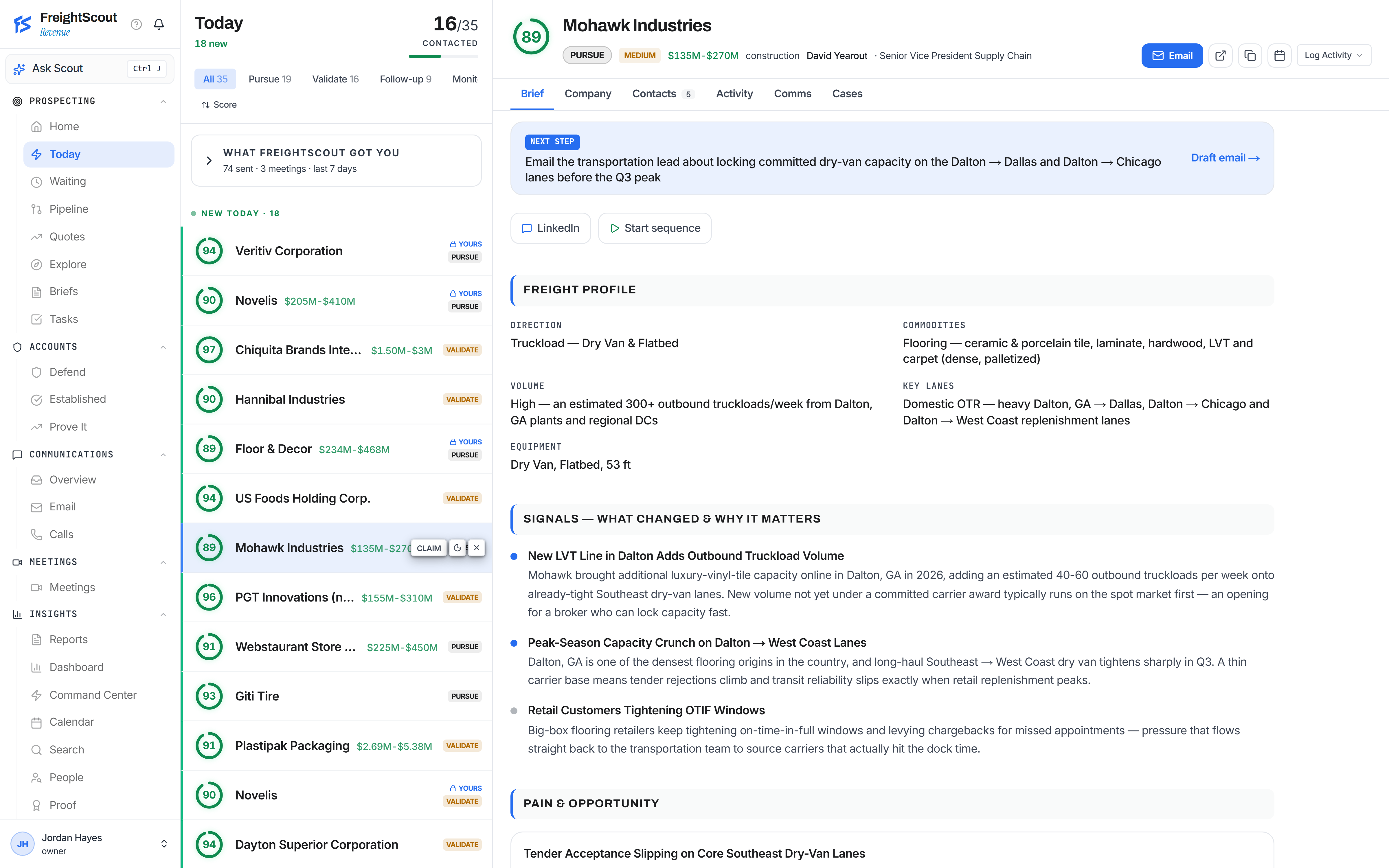
FreightScout is the AI execution layer for freight brokerages, built by people who ran one. It takes the check calls, tracking updates, tender responses, load building and carrier sourcing off the floor, and works the shippers and RFPs nobody had time for. Your A players spend the day selling.
FreightScout doesn't replace your best reps and coordinators. It hands them an agent for every job they hate. The research, the data entry, the follow-ups, the check calls: gone. What's left is the part only they can do: win the account, work the relationship, make the call. Give your top performer an agent for every one of those tasks and they do not just keep up. They run away with it. The goal is not getting people fired. The goal is you don't have to make the next ten hires.
FreightScout comes from 12 years in the business and a freight brokerage agency scaled into nine figures. Every workflow in it exists because we lived the problem. Built by operators, validated by reps. Not software tourists guessing at your day.
One system across the whole load, from the first touch to the money in the bank.
It reads your load history, finds the shippers tendering freight in lanes you already run, and drafts the outreach. You approve.
Spot and contract, priced off your own lane cost history and current buy rates. Shipper sell and carrier buy, to your ceiling.
The load built off the tender, the carrier vetted and booked, the check calls dialed, the quiet truck caught.
POD in, invoice out, exceptions caught before they age, payment chased.
Tender volume against the account's own baseline, comms going quiet, margin drift. The save drafted before the RFP goes out.
Scout knows every load, account, margin and signal you have. Ask who's slipping and it tells you why, with the datapoint. Then it drafts the email, logs the call, sets the follow-up. You approve. Clearing the flag is the logging.
Explore ScoutThree lanes are below your 90-day margin floor: ATL→MIA at 9%, DAL→PHX at 11%, CHI→ATL at 12%. ATL→MIA ran 22 loads in the last 30 days: the biggest bleed.
Rate case built: loads, dates, costs. Carrier win-back note drafted.
Every touch is pre-drafted for the prospect. You approve. Then it sends on schedule, follows up on its own, and stops the second they reply. No rep babysitting reminders.
Explore SequencesA shipper doesn't log in. It tenders loads. FreightScout watches what actually predicts a leaving customer: tender-volume collapse, comms-cadence drop, margin erosion, slow-pay drift. All of it fused into one weighted at-risk score.
Explore DefendThis isn't a swarm that watches and pings you. It's an agent workforce that does the work: building the load off the tender, booking and negotiating the carrier, running the check calls, and closing out collections and billing. Stage by stage, as you switch each one on, supervised or on full autopilot. Your call.
Explore the agent workforceAn AI voice agent runs your check calls, dialing carriers for pickup, transit and delivery status, capturing it live and escalating to a human the instant something's wrong. On the buy side, a deterministic engine negotiates carrier rates to your ceiling, never above it.
Explore voice agentsFreightScout learns which briefs, copy and timing actually win, and feeds it into the next draft, score and sequence.
Whatever TMS you run, FreightScout normalizes it into a single model. Carrier vetting, mailbox, phone, tracking and EDI connect today. Rate and load-board sources are built and connect on request.
The load building, carrier booking and check calls run supervised on live freight at a working brokerage today. Billing is built and gated on the customer's go.
FreightScout is built for freight brokerages and agencies. Carriers and customers get the doors they need into it. If your day runs through a TMS, tenders, routing guides and check calls, it was built for you, and all of it comes in one login. You pay for your people and your loads, and the AI your people use all day is included and never metered. The sales work runs in production today. The execution work runs supervised on live freight at a working brokerage and goes to autopilot when you say so. Nothing licensed separately, because your brokerage isn't two businesses.
Explore the platformApprove every send, or switch on full autopilot, per team and per action. Start supervised. Hand over the wheel when you trust it.
It cites the load, the lane, the margin behind every claim. It surfaces what's there. It never makes a number up.
Layers on the TMS you already run and reads it in place. No rip-and-replace, no migration project.
It works off your TMS and inbox as they are. No new system to feed, no CRM hygiene, no fields to maintain.

"Everything is gated by design, because the goal is to earn your trust as the customer. Then it's up to you whether you toggle full autonomy."